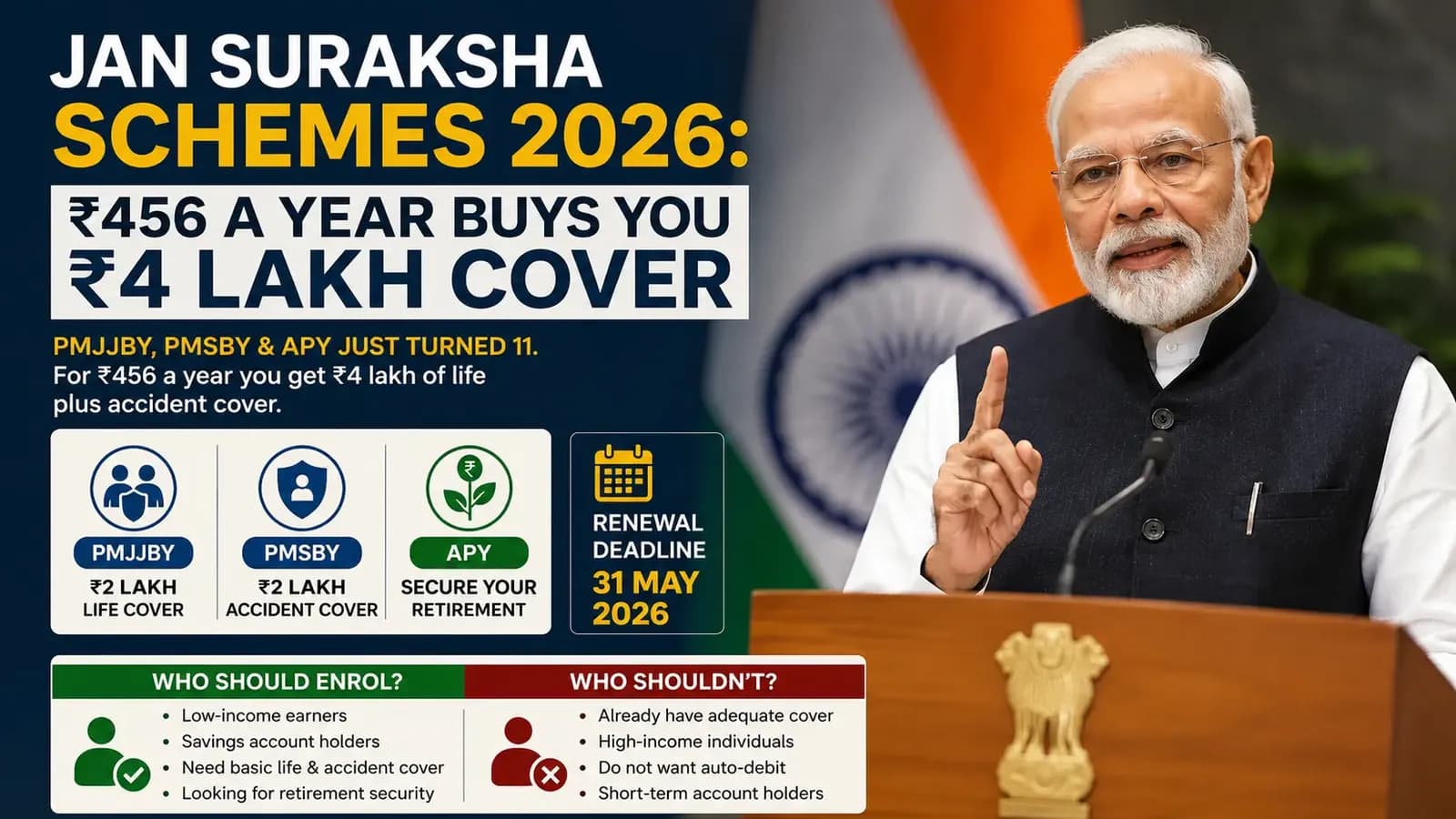
Jan Suraksha Schemes 2026: ₹456 a Year Buys You ₹4 Lakh Cover
On 9 May 2026, the Finance Ministry marked 11 years of India's three Jan Suraksha schemes — and the headline number is hard to ignore. Cumulative enrolments across PMJJBY, PMSBY and Atal Pension Yojana have crossed 94.56 crore, the Department of Financial Services said (PIB, 9 May 2026).
That's a lot of paperwork. But here's the part that matters for you: two of these schemes, together, hand you ₹4 lakh of life and accident cover for ₹456 a year. Less than most of us spend on chai in a month.
So the real question isn't whether the scheme is big. It's whether you — salaried log or chhoti dukaan ka maalik — should tick that auto-debit box before this year's renewal window closes on 31 May.
Quick Answer:
• PMJJBY: ₹2 lakh life cover for ₹436/year.
• PMSBY: ₹2 lakh accident cover for ₹20/year.
• Together: ₹4 lakh cover, ₹456/year, auto-debited from your bank account.
Disclaimer: This article is for educational purposes only and does not constitute investment advice. Munafa Lab is not a SEBI-registered investment advisor or research analyst. Investments in securities, mutual funds, gold, and other market instruments are subject to market risks; please read all scheme-related documents and consult a SEBI-registered financial advisor before investing.
What the Jan Suraksha schemes actually cover
Launched together on 9 May 2015 in Kolkata, the Jan Suraksha schemes were built for one job: give affordable protection to people the regular insurance market mostly ignored. Three separate products, three different problems.
PMJJBY (Pradhan Mantri Jeevan Jyoti Bima Yojana) is term life cover. If the policyholder dies for any reason, the family gets ₹2 lakh. It's administered by LIC and partner insurers. PMSBY (Pradhan Mantri Suraksha Bima Yojana) is accident cover — ₹2 lakh for accidental death or full disability. And Atal Pension Yojana (APY) is a small monthly pension after 60.
The scale tells you people are using them. As of 29 April 2026, PMJJBY had 27.43 crore enrolments and had settled ₹21,512.50 crore for over 10.75 lakh families. PMSBY crossed 58.09 crore enrolments with ₹3,667.52 crore paid across 1,84,662 claims. APY has gone past 9.04 crore subscribers.
The ₹456 math nobody explains properly
Most articles list the premiums and stop there. The interesting bit is the cost per rupee of cover — and that's where these Jan Suraksha schemes quietly beat almost everything else a low-income earner can buy.
SchemeBenefitAnnual premiumAge (entry)Cost per ₹1 lakh cover/year
PMJJBY
₹2 lakh life cover
₹436
18–50
₹218
PMSBY
₹2 lakh accident cover
₹20
18–70
₹10
Both combined
₹4 lakh total cover
₹456
18–50
₹114
Typical private term plan*
₹50 lakh life cover
₹6,000–9,000
18–65
₹120–180
*Indicative private term-plan rates for a healthy 30-year-old non-smoker; vary by insurer and health.
Here's the counter-intuitive bit. Most people think ₹2 lakh is too small to bother with. But for a household running on ₹15,000 a month, ₹2 lakh is more than a year's income — arriving in one DBT credit exactly when the family has zero plan. The cover is small in absolute terms, but huge relative to who it's protecting.
A Tier-2 reality check: Suresh in Indore
Numbers feel abstract, so take a real-shaped example. Suresh, 34, runs a mobile-repair shop in Indore. Annual income roughly ₹4.8 lakh, no employer, no group insurance. A private ₹50 lakh term plan quote came to about ₹8,400 a year — money he kept "planning" to spend and never did.
In June 2025 he ticked PMJJBY and PMSBY through his bank app instead. Total: ₹456 for the year, auto-debited. Not ₹50 lakh of cover — but ₹4 lakh that actually exists, versus the ₹50 lakh plan that existed only in his head.
That's the honest framing. Jan Suraksha isn't a replacement for a proper term plan if you can afford one. It's the floor — the cover that's better than the zero most informal earners are sitting on right now.
I'll be straight with you. For years I ignored PMSBY because ₹20 felt too trivial to take seriously. Then a cousin in Nashik, a delivery rider, had a road accident in 2024, and that ₹2 lakh accident payout covered three months his family otherwise had nothing for. ₹20 stopped looking trivial after that.
Atal Pension Yojana: the long game
APY is the slow one. You pick a target pension — ₹1,000, ₹2,000, ₹3,000, ₹4,000 or ₹5,000 a month — and pay a fixed monthly contribution till 60. After that, you get that pension for life, and your spouse continues it after you. The earlier you start, the smaller your monthly contribution.
Who APY suits
APY is open to anyone aged 18–40 with a bank account. It fits gig workers, shopkeepers and home-makers who have no EPF or NPS. A 25-year-old targeting ₹5,000/month pays roughly ₹376 a month — kaam ki baat yeh hai ki itni si SIP retirement floor bana deti hai.
One concrete step you can take this week
The PMJJBY and PMSBY cover year runs 1 June to 31 May, and premiums auto-debit around late May. So this is the actual window. Open your bank app, find the "insurance" or "social security / Jan Suraksha" section, and switch on auto-debit consent for both before 31 May. You can also enrol at the official Jan Suraksha portal or your branch. For APY, the NSDL APY page has the contribution chart.
Who should NOT rely on these alone
If you're the sole earner for a family with home loan EMIs and kids' fees, ₹4 lakh won't clear even a year of obligations. You need a real ₹50 lakh–₹1 crore term plan, and Jan Suraksha sits on top as a bonus, not the main cover. Treat it as the first brick, not the whole wall.
For deeper reading, see our guides on how Atal Pension Yojana contributions work and term insurance vs PMJJBY.
FAQs
What are the Jan Suraksha schemes?
They're three government social-security schemes launched in May 2015: PMJJBY (life cover), PMSBY (accident cover) and Atal Pension Yojana (pension). Together they crossed 94.56 crore enrolments by April 2026.
How much premium for PMJJBY in 2026?
₹436 per year for ₹2 lakh life cover, auto-debited from your linked bank account once a year. The cover renews annually from 1 June.
What is the difference between PMJJBY and PMSBY?
PMJJBY pays ₹2 lakh on death from any cause and costs ₹436/year. PMSBY pays ₹2 lakh only for accidental death or permanent disability and costs ₹20/year. Many people take both.
Who is eligible for Atal Pension Yojana?
Any Indian aged 18–40 with a bank account. You contribute monthly till 60, then receive a guaranteed ₹1,000–₹5,000 monthly pension, with the same continuing for your spouse afterward.
How to enrol in Jan Suraksha schemes online?
Use your bank's net-banking or mobile app and look for the Jan Suraksha or social-security section, or visit jansuraksha.gov.in. You need an active savings account and an Aadhaar-linked mobile number.
Can I take both PMJJBY and PMSBY together?
Yes. Most people enrol in both, paying a combined ₹456 a year for ₹4 lakh of total life-plus-accident cover. They're independent, so a claim on one doesn't affect the other.
If you've never set up any protection, start small this week — switch on PMJJBY and PMSBY through your bank, then read our 2026 government schemes guide to plan the next step.
Last verified: 2026-05-20. Tax rules, interest rates, gold prices, and product features change frequently. Verify the latest figures on official sources (incometax.gov.in, amfiindia.com, sebi.gov.in, rbi.org.in, ibja.co) before acting on this article.
Stay subscribed