F&O STT Hike 2026: How New Rates Hit Your Trading Costs
If you traded a single Nifty options lot last week, the government took a bigger slice than it would have eighteen months ago. The Securities Transaction Tax on F&O has climbed in two waves since October 2024, and the full FY26 impact is now sitting on every retail brokerage statement. NSE turnover data shows average daily premium turnover in index options crossed Rs 76,400 crore in April 2026.
So what changed, and how much does it cost per lot? Bigger question: does the math still work for small retail traders running 5-10 lot positions on weekly expiries?
Here's the actual rate card, the real per-trade cost, and three shifts that serious retail traders have made since FY26 began.
Bottom line:
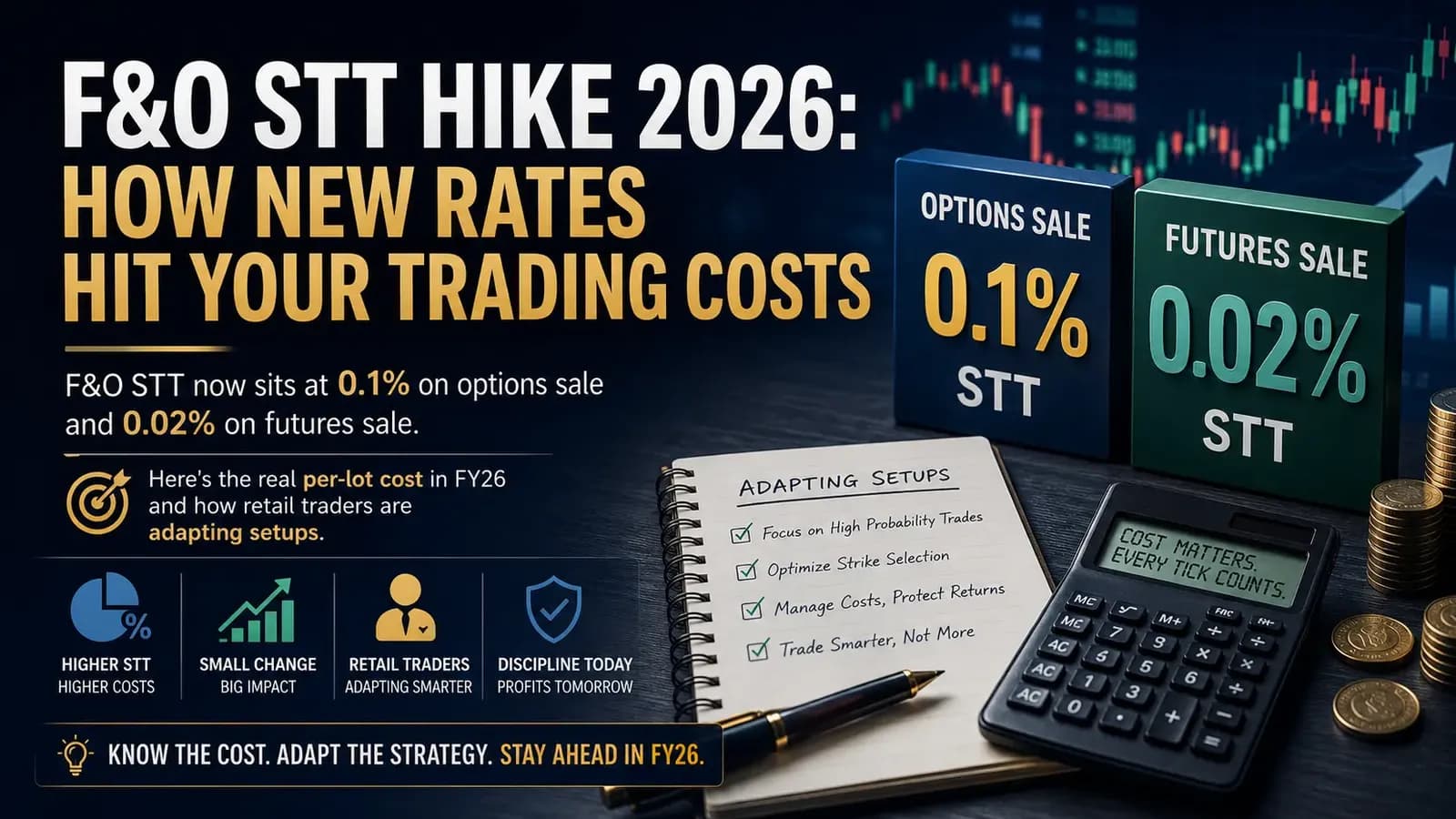
- STT on options sale: 0.1% of premium since 1 October 2024
- STT on futures sale: 0.02% of trade value since 1 October 2024
- Brokerage + STT + GST can eat 12-18% of gross profit on weekly options
Disclaimer: This article is for educational purposes only and does not constitute investment advice. Munafa Lab is not a SEBI-registered investment advisor or research analyst. Investments in securities, mutual funds, and other market instruments are subject to market risks; please read all scheme-related documents and consult a SEBI-registered financial advisor before investing.
Affiliate disclosure: Some links in this article are affiliate links. If you sign up through them, Munafa Lab may earn a commission at no additional cost to you. This does not influence our editorial rankings.
What Actually Changed in the STT Structure
The July 2024 Union Budget proposed two specific hikes on F&O transactions. Both kicked in on 1 October 2024. STT on the sale of equity options rose from 0.0625% to 0.1% of option premium. STT on the sale of equity futures moved from 0.0125% to 0.02% of trade value. The rates have stayed put through the Budget tabled by the Finance Minister in February 2026, which means FY26 (April 2025 - March 2026) was the first full year with the new structure baked in.
The Finance Ministry's PIB release dated 23 July 2024 framed the hike as a "rationalisation" measure aimed at curbing speculative retail volumes. The trigger was a sharp jump in retail F&O participation through FY22-FY24.
The effect on traders is simple. Every sell-side leg of an options trade pays 60% more STT than before. Every futures sell-side leg pays 60% more too. Buy-side STT on options stays at 0.0625% on premium — unchanged. So a complete round-trip in options costs more on the closing leg, every single time.
A worked example on Bank Nifty options
Say you sell one Bank Nifty 50,000 CE lot of 15 quantity at a premium of Rs 250. Premium turnover is 15 × 250 = Rs 3,750. STT at 0.1% on the sell leg is Rs 3.75. Before October 2024, the same trade would have cost Rs 2.34 in STT. The Rs 1.41 extra per lot looks small. Compounded across 50 lots a month, that's an extra Rs 70 — and that's just one tax, on one side, of one strike.
SEBI's Six-Step Reform — What Else Is Squeezing F&O
STT isn't operating in isolation. SEBI released a six-point reform package on 1 October 2024 that ran in parallel with the STT hike. The package made weekly expiries available on only one benchmark index per exchange, raised contract sizes from roughly Rs 5 lakh to Rs 15-20 lakh, and removed calendar spread treatment on expiry day.
NSE has since kept Nifty 50 weekly expiry alive. BSE retains Sensex weekly. Bank Nifty, FinNifty, Nifty Midcap Select, and Nifty Next 50 all lost their weekly products through 2024-25. The combined effect on retail volume has been brutal — and visible.
SEBI's retail F&O study released in January 2025 reported that 91.1% of individual F&O traders booked losses in FY24, with the average loss at Rs 1.2 lakh. NSE volume data for April 2026 shows index options premium turnover is down roughly 35% from the September 2024 peak. Fewer expiries plus fatter contracts plus higher STT is doing exactly what regulators wanted — thinning out small retail speculation.
How Much STT Are You Actually Paying?
Most retail traders never see STT as a separate number. It's bundled into the contract note alongside GST, exchange transaction charges, SEBI fee, and stamp duty. But when you pull the breakup, the share matters. On a typical Rs 3,000 weekly options scalp profit, total cost stack runs Rs 250-450 depending on broker plan. STT alone is the second-largest line after brokerage on discount platforms, and it has no upper cap.
Here's how the math shakes out for four common retail trade profiles. All numbers are in rupees for one round trip:
Trade ProfileLot Size & PremiumSTT (Old Rate)STT (New Rate)Extra Cost
Nifty 50 CE/PE
75 qty @ Rs 150
7.03
11.25
4.22
Bank Nifty CE/PE
15 qty @ Rs 250
2.34
3.75
1.41
Nifty futures
75 qty @ Rs 22,500
210.94
337.50
126.56
Sensex weekly options
20 qty @ Rs 180
2.25
3.60
1.35
Futures pay the biggest absolute hit because STT is charged on full contract value, not premium. Most retail traders stick to options for exactly this reason.
The First-Person Bit: What I Changed in My Own Trading
I've tracked my own F&O charges line by line since FY23, and the post-October 2024 quarter forced a rethink. My total cost per Nifty options round trip rose from roughly Rs 38 to Rs 48 on a 75-lot trade after the hike. Across 80-100 trades a month, that's an extra Rs 800-1,000 in tax alone — money that used to stay in my account. So I cut weekly index option scalps from four expiries down to one, moved to monthly positional trades on Nifty, and shifted intraday scalp attempts to cash-segment Nifty Bees ETF instead. The cost stack on Nifty Bees is a fraction of options. Returns haven't shifted as much as I feared, because most of my old weekly P&L was being eaten by costs anyway.
What Smart Retail F&O Traders Are Doing in FY26
Three patterns are showing up in trader behaviour, based on broker disclosures and exchange volume data. First, average holding periods are getting longer — fewer scalp trades, more multi-day swing setups. Second, vertical spreads and credit spreads are gaining share over naked options, because spreads cap both risk and the percentage cost drag. Third, ETF-based momentum strategies are pulling volume that used to sit in weekly options.
If you must trade weekly options
Stick to Nifty 50 weekly on NSE or Sensex weekly on BSE. These are the only two surviving weekly products on indices. Avoid out-of-the-money options far from spot, because cost as a percentage of premium rises sharply when premiums are tiny. A Rs 5 option paying Rs 0.5 STT per lot is a 10% drag before you've moved a single tick. If you want lower-cost equity exposure with similar daily action, look at large-cap index ETFs or even discount-broker margin trading on liquid Nifty 50 names.
Tax Treatment of F&O Profits
STT is one charge. Income tax on F&O profits is another. F&O income is treated as non-speculative business income under Section 43(5) of the Income Tax Act. That means it's taxed at slab rates, but you can deduct all costs — STT itself, brokerage, internet, depreciation on trading hardware, and a share of rent if you trade from home.
Worth flagging: STT on F&O is fully deductible as a business expense. That's different from STT on equity delivery, where STT gets added to acquisition cost. So the bigger STT line on FY26 contract notes will reduce your taxable F&O profit. It's a small saving for those in the 30% slab — not enough to compensate for the absolute cost increase, but it helps.
If your annual F&O turnover crosses Rs 10 crore (the audit threshold under Section 44AB as of FY26), you'll need a tax audit. Most retail traders don't hit this, but it's worth tracking. Read more on how to file ITR-3 for F&O traders before 31 July 2026.
FAQs
When did the new F&O STT rates come into effect?
The current rates — 0.1% on options sale and 0.02% on futures sale — came into effect on 1 October 2024 under the July 2024 Union Budget. They've remained unchanged through the Budget tabled in February 2026.
Is STT charged on the buy side too?
For options, STT is charged on both buy (0.0625% on premium) and sell (0.1% on premium) legs, but the buy-side rate is the older, lower one. For futures, STT is only charged on the sell side at 0.02% of trade value.
Can I claim STT back in my tax return?
Yes, for F&O income. Since F&O is treated as business income, STT paid is fully deductible as a business expense in your ITR-3. This isn't the case for equity delivery STT, which has different treatment under capital gains rules.
Are SIP-style strategies on options affected?
Cash-and-carry strategies and protective puts on long-term holdings face higher transaction friction because of the STT hike, but the per-trade impact is smaller for low-frequency strategies. Day scalpers and weekly options sellers feel it most.
How do I see the exact STT on each trade?
Pull the contract note from your broker. Zerodha, Groww, Upstox, and Angel One all break out STT separately on their daily reports. Cross-check the rate against SEBI's official circular published on its website.
Will the government roll back the STT hike?
No reversal has been announced or hinted at in any official communication from the Finance Ministry or SEBI as of May 2026. The hike is structural and forms part of the broader retail-F&O cooling-off measures.
Is index options trading still profitable after the hike?
It can be, but the cost drag means smaller traders need higher win rates or larger position sizing to stay profitable. SEBI's own study indicates the majority of retail F&O traders lose money even before the STT hike kicked in.
If you want a discount-broker setup with transparent STT reporting and one-click P&L exports for ITR-3 filing, open a Zerodha trading account — it remains the lowest-cost route for active F&O traders in FY26. Compare options first with our discount broker comparison before signing up.
Last verified: 18 May 2026. Tax rules, interest rates, and product features change frequently. Verify the latest figures on official sources (incometax.gov.in, amfiindia.com, sebi.gov.in, rbi.org.in) before acting on this article.
Stay subscribed