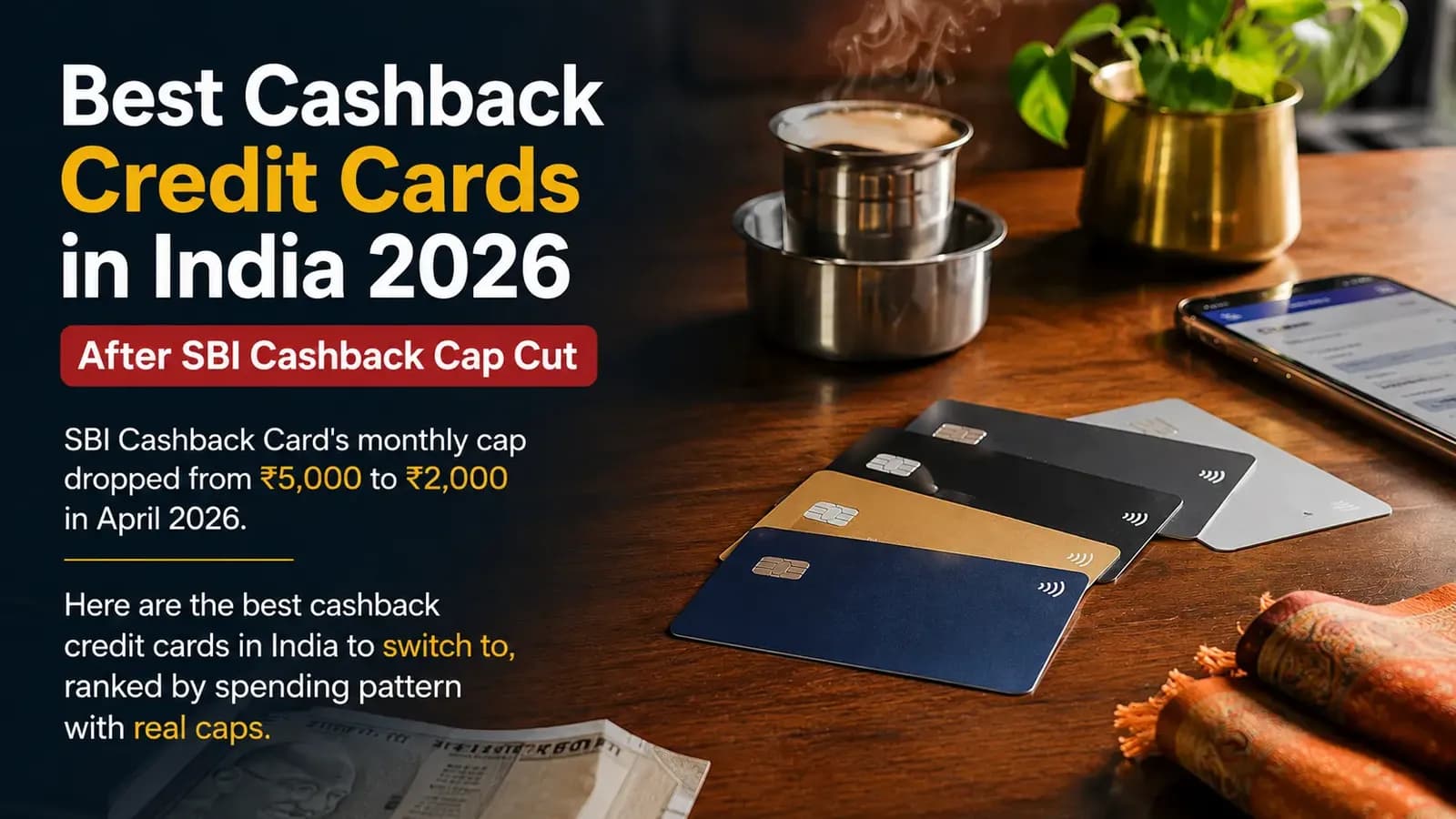
Best Cashback Credit Cards in India 2026 After SBI Cashback Cap Cut
On 1 April 2026, SBI Card quietly changed something that affected millions of cardholders. The SBI Cashback Card's monthly cashback cap was cut from ₹5,000 to ₹2,000. For anyone spending ₹30,000-₹50,000 a month on online shopping, that's a real income cut.
The 5% cashback on online spends is still there. But hitting that ceiling now takes just ₹40,000 of online spend in a month — and millions of cardholders are looking around for alternatives.
This guide ranks the strongest cashback credit cards in India for 2026, broken down by spending pattern, with the actual reward caps and the small print that decides whether a card stays in your wallet.
Quick Answer
- SBI Cashback Card capped at ₹2,000/month from April 2026 (down from ₹5,000)
- Amazon Pay ICICI leads for Amazon-heavy spenders (5% for Prime members, no cap)
- Kiwi Axis RuPay covers UPI payments at 1.5%, lifetime free — a category most cards skip
Disclaimer: This article is for educational purposes only and does not constitute investment advice. Munafa Lab is not a SEBI-registered investment advisor or research analyst. Investments in securities, mutual funds, and other market instruments are subject to market risks; please read all scheme-related documents and consult a SEBI-registered financial advisor before investing.
Affiliate disclosure: Some links in this article are affiliate links. If you sign up through them, Munafa Lab may earn a commission at no additional cost to you. This does not influence our editorial rankings.
Why SBI Cashback's ₹2,000 Cap Changed Everything
The SBI Cashback Card was the default recommendation for online-heavy spenders for almost three years. The reason was simple: a flat 5% cashback on online spends with a ₹5,000 monthly cap, no merchant exclusions worth mentioning, and a low ₹999 annual fee waived on ₹2 lakh annual spend.
The April 2026 revision changed two things. The cap dropped to ₹2,000 a month — capping the value at roughly ₹24,000 a year instead of the earlier ₹60,000. And SBI added a 1% cashback ceiling on utility-bill payments, which had been a sneaky way some users were maxing out the card.
For users spending less than ₹40,000 a month online, the card still works. For everyone else, the math now points elsewhere.
2026 Cashback Credit Cards Compared
Cashback cards in India fall into three rough tiers in 2026: high-reward online cards with a brand tie-up, broad-spectrum cards with category accelerators, and the new wave of UPI-linked RuPay cards. The table below maps the strongest option in each tier against your typical monthly spending pattern.
CardAnnual FeeTop Cashback RateMonthly CapBest For
Amazon Pay ICICI
₹0 (lifetime free)
5% on Amazon (Prime)
No cap on Amazon
Amazon-heavy buyers
HDFC Tata Neu Infinity
₹1,499
5% on Tata Neu app
₹2,000/cycle
Tata ecosystem users
Flipkart Axis Bank
₹500
5% on Flipkart/Myntra
₹4,000/quarter
Flipkart loyalists
Kiwi Axis RuPay
₹0 (lifetime free)
1.5% on UPI spends
₹500/month
UPI-first users
BPCL SBI Octane
₹1,499
7.25% value-back on fuel
₹2,500/month fuel
Daily commuters
SBI Cashback (revised)
₹999
5% online
₹2,000/month
Low online spenders
The honest takeaway: no single card now dominates the way the old SBI Cashback Card did. Most savvy users in 2026 carry two cards — one for the brand ecosystem they shop in most, and one to catch the spends that fall outside (fuel, UPI, offline).
Best for Online Spends: Amazon Pay ICICI Card
For anyone whose monthly Amazon spend crosses ₹10,000, this card is now the clear winner. Prime members earn 5% cashback on every Amazon purchase with no cap. Non-Prime members earn 3%. Cashback comes back as Amazon Pay balance — usable on the next Amazon purchase, on Amazon Pay UPI payments, or on merchants who accept Amazon Pay.
What makes it sharper in 2026: the card carries no annual fee, no joining fee, and no minimum spend requirement to keep it active. The 1% cashback on other merchant categories isn't market-leading, but for an entirely free card, it's a clean keep-in-wallet option.
I've personally tracked my Amazon Pay ICICI cashback for two years, and on ₹18,000-₹22,000 monthly Amazon spend, the card returns ₹900-₹1,100 a month in usable balance. That's a free year of Prime, paid for by the card itself.
The eligibility is straightforward — a CIBIL score above 750 and stable income usually gets approval within 48 hours. You can apply through ICICI's online portal directly.
Best for Offline and UPI: HDFC Tata Neu and Kiwi Axis
HDFC Tata Neu Infinity for ecosystem spends
If you shop at Croma, BigBasket, Tata 1mg, Tata CLiQ, or fly on Air India regularly, the Tata Neu Infinity card returns 5% as NeuCoins on Tata brand spends and 1.5% on other spends. The annual fee is ₹1,499 — recoverable if you spend more than ₹8 lakh a year on the card.
The catch: NeuCoins are redeemable only within the Tata ecosystem. That works if your monthly grocery and pharmacy spend already runs through BigBasket and 1mg. It's restrictive if you mostly shop at Reliance or independent kirana stores.
Kiwi Axis RuPay for UPI payments
UPI now accounts for over 60% of digital payments in India by volume, but most credit cards don't earn rewards on UPI transactions. The Kiwi Axis RuPay card changed that — it offers 1.5% cashback on UPI spends with a ₹500 monthly cashback cap, lifetime free, with no joining fee.
For someone running ₹30,000 a month of grocery, vegetables, kirana and food-delivery payments through UPI, that's ₹450-₹500 back every month. Over a year, that's ₹5,400-₹6,000 — roughly the value of a mid-tier card's joining-fee benefit, but earned passively.
Best for Fuel: BPCL SBI Octane Card
Fuel cashback has become a category of its own in 2026 thanks to fuel prices staying elevated through most of FY26. The BPCL SBI Octane card returns 25 reward points per ₹100 on fuel spends at BPCL outlets — translating to a 7.25% value-back when redeemed at the SBI rewards rate. The monthly cap is ₹2,500 on fuel value-back, with a ₹1,499 annual fee.
If you fill up ₹6,000-₹8,000 of fuel a month at BPCL pumps, the card earns its keep within four months and then runs at a clean profit. The fuel surcharge waiver (up to ₹100 per cycle) is a small bonus.
It's not the right card if you fill up at Indian Oil or HPCL pumps — the accelerated rate is BPCL-only.
How to Pick the Right Cashback Card for Your Spending
The simplest way to choose is to look at your last three credit-card statements and tag each transaction by category. Add up the totals. The card you pick should give the highest cashback on the top two categories — not the best headline rate.
A common mistake: chasing a 5% headline rate on a card with a ₹2,000 monthly cap when most of your spend sits in a category that earns only 1%. The effective rate ends up at 1.3-1.5% — worse than a flat-rate card.
For most readers in 2026, a two-card setup works best. One card for your primary ecosystem (Amazon, Flipkart, Tata, or whichever brand you spend most with). One general-purpose card for the spends that fall outside — fuel, offline retail, UPI, utility bills. Apply for the next card only after you've used the first for at least six months without missing a payment, since credit-utilisation ratios and CIBIL scores prefer that pattern.
For a tailored shortlist matched to your exact spend pattern, you can use the CardInsider matching tool or BankBazaar's credit card comparison — both are free.
FAQs
Is the SBI Cashback Card still worth getting in 2026?
Yes, if your monthly online spend is under ₹40,000. The 5% rate is still strong, and ₹2,000 monthly cashback covers most casual users. Above ₹40,000 monthly online spend, the cap becomes the bottleneck.
Which cashback credit card has no monthly cap?
Amazon Pay ICICI has no cap on Amazon spend cashback (5% for Prime members, 3% for others). Most other cashback cards in India have either a monthly or quarterly cap on the accelerated category.
Can I get a cashback credit card without a credit history?
Yes. Kiwi Axis RuPay and some other UPI-linked cards have lower approval thresholds. Secured credit cards against an FD are also an option for first-time borrowers building a CIBIL score.
How is cashback different from reward points?
Cashback is credited as a statement credit or a usable balance (like Amazon Pay) at a fixed rate. Reward points need to be redeemed against a catalogue and often have variable redemption rates — sometimes only 25-30 paisa per point.
Do credit card cashback amounts get taxed?
Cashback is not treated as taxable income in India as long as it's earned on personal spending. Cashback earned on business expenses can attract scrutiny if the business has claimed the original spend as a deduction.
Should I close the SBI Cashback Card after the April 2026 changes?
Don't close it if it's your oldest credit card — closing it shortens your credit history and can lower your CIBIL score. Keep it active with a small recurring spend and use a higher-cap card for your main online shopping.
What's the best card if I want only one cashback card?
For most Indian shoppers, the Amazon Pay ICICI card is the simplest single-card answer in 2026 — it's lifetime free, has no spend caps on Amazon, and gives a flat 1% on other merchants.
What to Do Next
Pull your last three credit-card statements, tag each transaction, and run the numbers against the table above. If your top spending category is online retail at Amazon, the Amazon Pay ICICI card is the cleanest swap from the revised SBI Cashback. If your spending is split across UPI, fuel and brand stores, a two-card setup with Kiwi Axis RuPay plus one ecosystem card will return more value than chasing a single high-fee premium card.
Last verified: 17 May 2026. Tax rules, interest rates, and product features change frequently. Verify the latest figures on official sources (incometax.gov.in, amfiindia.com, sebi.gov.in, rbi.org.in) before acting on this article.
Stay subscribed